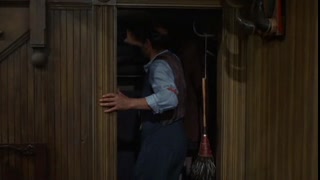
THX 1138 (1971)

Toonarly
Published on Sep 25, 2024
THX 1138 (1971) (Movie is in the public Domain)
THX 1138 is a 1971 American social science fiction film co-written and directed by George Lucas in his directorial debut. Produced by Francis Ford Coppola and co-written by Walter Murch, the film stars Robert Duvall and Donald Pleasence, with Don Pedro Colley, Maggie McOmie, and Ian Wolfe in supporting roles. The film is set in a dystopian future in which the citizens are controlled by android police and mandatory use of drugs that suppress emotions.
THX 1138 was developed from Lucas's 1967 student film Electronic Labyrinth: THX 1138 4EB, which he created while attending the USC School of Cinematic Arts. The feature film was produced in a joint venture between Warner Bros. and American Zoetrope. A novelization by Ben Bova was published in 1971.
The film received mixed reviews from critics and underperformed at the box office upon its initial release,[3] but it has subsequently received critical acclaim and gained a cult following, particularly in the aftermath of Lucas's success with Star Wars (1977). A director's cut prepared by Lucas was released in 2004.
Plot
The film's title card
In the dystopian future, sexual intercourse and reproduction are prohibited, and mind-altering drugs are mandatory to enforce compliance among the citizens and to ensure their ability to conduct dangerous and demanding tasks. Workers wear identical white uniforms and have shaven heads to emphasize uniformity, likewise with police androids who wear black and monks who are robed. Instead of names, people have designations with three arbitrary letters (referred to as the "prefix") and four digits, shown on an identity badge worn at all times.
At their jobs in central video control centers, SEN 5241 and LUH 3417 keep surveillance on the city. LUH has a male roommate named THX 1138, who works in a factory producing android police officers. At the beginning of the story, THX finishes his shift while the loudspeakers urge the workers to "increase safety"—and congratulate them for only losing 195 workers in the last period—to the competing factory's 242.
On the way home, he stops at a confession booth in a row of many, and relates his concerns and mumbles prayers about "party" and "masses", under the Jesus Christ-esque portrait of "OMM 0000". A soothing voice greets THX, and OMM ends the confession with a parting salutation: "You are a true believer, blessings of the State, blessings of the masses. Work hard, increase production, prevent accidents, and be happy."
At home, THX takes his drugs and watches holobroadcasts while engaging with a masturbatory device. LUH secretly substitutes pills in her possession for THX's medications, causing him to develop nausea, anxiety, and sexual desires. LUH and THX become involved romantically and have sex. THX later is confronted by SEN, who attempts to arrange that THX become his new roommate, but THX files a complaint against SEN for the illegal shift pattern change.
Without drugs in his system, THX falters during a critical and hazardous phase of his job, and a control center engages a "mind lock" on THX which raises the level of danger. After the release of the mind lock, THX makes the necessary correction to that work phase. THX and LUH are arrested and THX undergoes drug therapy and medical analysis. He enjoys a brief reunion with LUH, but it is disrupted shortly after she reveals her pregnancy.
At THX's trial, it is stated that THX was clinically born. It is decided that it would be inefficient to terminate THX, so THX is sentenced to prison, alongside SEN. THX and SEN walk to search for an exit. Eventually they are joined by hologram actor SRT 5752, who starred in the holobroadcasts. SRT 5752 shows them the exit and suggests to them that they may have been going in circles. During the escape, THX and SRT are separated from SEN. Chased by the police androids, THX and SRT are trapped in a control center, from which THX learns that LUH has been "consumed", and her name has been reassigned to her fetus, numbered 66691, in a growth chamber. SEN eventually escapes to an area reserved for the monks of OMM, where a monk notices that SEN has no identification badge. SEN attacks him and later wanders into a child-rearing area, strikes up a conversation with children, and sits aimlessly until police androids apprehend him. THX and SRT steal two cars. SRT struggles to figure out how to drive the car. When SRT finally gets the car to move, SRT immediately crashes his car into a concrete pillar. After the crash, SRT is not found in the vehicle.
Pursued by two police androids on motorcycles, THX flees to the limits of the city. Android officers continue to pursue him as he briefly struggles with simian-like creatures identified as shell dwellers and arrives at a vertical shaft with an escape ladder. The android officers are ordered by Central Command to cease pursuit, on the grounds that the expense of his capture exceeds their allocated budget for THX. The officers inform THX that the area outside the "city shell" is uninhabitable in a last-ditch attempt to convince him to surrender, but he is undeterred and continues up the ladder. The city is then revealed to be entirely underground, and THX has escaped onto the surface, where he witnesses the Sun setting.
Cast
Hans Memling's Christ Giving His Blessing (1478) is used as the visual representation of the state-sanctioned deity OMM 0000.
Robert Duvall as THX 1138
Donald Pleasence as SEN 5241
Maggie McOmie as LUH 3417
Don Pedro Colley as the hologram actor SRT 5752
Ian Wolfe as the old prisoner PTO
Marshall Efron as prisoner TWA
Sid Haig as prisoner NCH
John Pearce as prisoner DWY
James Wheaton as the voice of OMM 0000
The announcer voices include those of Scott Beach, Terence McGovern, and David Ogden Stiers (billed as David Ogden Steers), all of whom had ties to the San Francisco Bay area, as did Lucas.
Production
THX 1138 is the first film of a planned seven-picture slate commissioned by Warner Bros. from the 1969 incarnation of American Zoetrope.[4][5] Lucas wrote the initial script draft based on his earlier short film, but Coppola and Lucas agreed that it was unsatisfactory. Walter Murch assisted Lucas in writing an improved final draft.[1][2] For some of SEN's dialogue in the film, the script included excerpts from speeches by Richard Nixon.[6]
The script required almost the entire cast to shave their heads, either completely bald or with buzz cuts. As a publicity stunt, several actors were filmed having their first haircuts and shaves at unusual venues, with the results used in a promotional featurette titled Bald: The Making of THX 1138. Many of the extras were recruited from the nearby Synanon, an addiction-recovery program that later became a violent cult.[7]
Filming began on September 22, 1969.[8] The schedule was planned for 35–40 days, completing in November 1969. Lucas filmed THX 1138 in Techniscope.[1][9]
Most filming locations are in the San Francisco area,[10] including the unfinished tunnels of the Bay Area Rapid Transit subway system,[1][10][11] the Lawrence Livermore National Laboratory,[1] the Marin County Civic Center in San Rafael designed by Frank Lloyd Wright,[11] the Lawrence Hall of Science in Berkeley,[11] the San Francisco International Airport[11] and at a remote manipulator for a hot cell. Several scenes show one of the FAA 9020 IBM System/360 used for air trafic control multi-computer installation (the only version with a "360 Mode" button on the console).[12] Studio sequences were shot at stages in Los Angeles, including a white stage 100 by 150 feet (30 by 46 m) for the "white limbo" sequences.[1] Lucas used entirely natural light.[11]
Modified Lola T70s were used in the film
The chase scene features two Lola T70 Mk III race cars[13] chased by Yamaha TA125/250cc two-stroke, race-replica motorcycles through two San Francisco Bay Area automotive tunnels: the Caldecott Tunnel between Oakland and Orinda and the underwater Posey Tube between Oakland and Alameda.[1] According to Caleb Deschanel, cars drove at speeds of 140 miles per hour (230 km/h) while filming the chase.[1] Other cars appearing in the film include custom-built Ferrari Thomassima cars, one of which is on display in the Ferrari museum in Modena, Italy.[14]
The chase features a motorcycle stunt in which stuntman Ronald "Duffy" Hambleton (credited as Duffy Hamilton) rode his police motorcycle full speed into a fallen scaffold, with a ramp built to his specification. He flew over the handlebars, was hit by the airborne motorcycle, landed in the street on his back, and slammed into the crashed car in which Duvall's character had escaped.[1] According to Lucas, Hambleton was uninjured but angry at the people who came to his aid, worried that they may have ruined the stunt by walking into frame.[citation needed]
The under-construction Transbay Tube served as the tunnel through which THX escapes
THX's final climb out to the daylight was filmed (with the camera rotated 90°) in the incomplete (and decidedly horizontal) Bay Area Rapid Transit Transbay Tube before installation of the track supports, with the actors using exposed reinforcing bars on the floor of the tunnel as a ladder.[1] The end scene in which THX stands before the sunset was shot at Port Hueneme, California by a second unit of photographer Caleb Deschanel and Matthew Robbins, who played THX in this long shot.[1]
After completion of photography, Coppola scheduled one year for Lucas to complete postproduction.[15] Lucas edited the film on a German-made K-E-M flatbed editor in his Mill Valley house by day and Walter Murch edited sound at night, comparing notes as each session ended.[1][15] Murch compiled and synchronized the sound montage, which includes elements such as the "overhead" voices, radio chatter and announcements. The bulk of the editing was finished by mid-1970.[citation needed]
On completion of editing, Coppola took it to Warner Bros., the financiers. Studio executives disliked the film and insisted that Coppola provide the negative to an in-house editor, who cut about four minutes of the film prior to release.[16]
Soundtrack
THX 1138
Soundtrack album by Lalo Schifrin
Released 1970
Recorded October 15–16, 1970
Studio The Burbank Studios, Burbank, California, U.S.
Genre Experimental
Length 55:36
The soundtrack to THX 1138, conducted by Lalo Schifrin, was released in 1970. Recording took place on October 15 and 16, 1970 at the Burbank Studios in Burbank, California.[17]
Track listing
Logo – 00:08
Main Title / What's Wrong? – 03:14
Room Tone / Primitive Dance – 01:46
Be Happy / LUH / Society Montage – 05:06
Be Happy Again (Jingle of the Future) – 00:56
Source #1 – 05:18
Loneliness Sequence – 01:28
SEN / Monks / LUH Reprise – 02:44
You Have Nowhere to Go – 01:12
Torture Sequence / Prison Talk Sequence – 03:42
Love Dream / The Awakening – 01:47
First Escape – 03:01
Source #3 – 03:34
Second Escape – 01:16
Source #4 / Third Escape / Morgue Sequence / The Temple / Disruption / LUH's Death – 08:31
Source #2 – 03:17
The Hologram – 00:56
First Chase / Foot Chase / St. Matthew's Passion (Bach) (End Credits) – 07:40
Reception
Critic Roger Ebert praised the film's visuals.
THX 1138 was released to theaters on March 11, 1971, and was a commercial flop, earning $945,000 in rentals for Warner Bros. and an overall loss for the studio.[16] A contemporary survey found seven favorable, three mixed and five negative reviews.[18]
Roger Ebert of the Chicago Sun-Times awarded the film three stars out of four and wrote, "THX 1138 suffers somewhat from its simple storyline, but as a work of visual imagination it's special, and as haunting as parts of 2001: A Space Odyssey, Silent Running, and The Andromeda Strain."[19] Gene Siskel of the Chicago Tribune awarded two stars out of four and stated, "The principal problem with this film is that it lacks imagination, the essential component of a science fiction film. Some persons might claim that the world of THX 1138 is here right now. A more reasonable opinion would hold that we are facing the problems of that world right now. Time has passed the film by."[20]
Vincent Canby of The New York Times wrote, "It is not, however, as either chase drama, or social drama, that THX 1138 is most interesting. Rather it's as a stunning montage of light, color and sound effects that create their own emotional impact ... Lucas's achievement in his first feature is all the more extraordinary when you realize that he is 25 years old, and that he shot most of the film in San Francisco, on a budget that probably would not cover the cost of half of one of the space ships in Stanley Kubrick's 2001."[21]
Arthur D. Murphy of Variety observed, "Likely not to be an artistic or commercial success in its own time, the American Zoetrope (Francis Ford Coppola group) production just might in time become a classic of stylistic, abstract cinema."[22] Charles Champlin of the Los Angeles Times praised the film as "a stunning deployment of the aural and visual resources of the screen to suggest a fearful new world of tyranny by technology", adding that "Lucas is obviously a master of cinematic effects with a special remarkable gift for discovering the look of the future in mundane places like parking structures and office corridors." Champlin stressed that the "real excitement of THX 1138 is not really the message but the medium — the use of film not to tell a story so much as to convey an experience, a credible impression of a fantastic and scary dictatorship of tomorrow."[23]
Kenneth Turan wrote in The Washington Post, "Fortunately, the film comes over not at all trite but rather as enormously affecting. Lucas obviously believed strongly in this futuristic vision, and the film draws its vitality and unity from his belief, and from the fact that it was not bottled up to meet arbitrary conditions but allowed the free rein necessary to reach completeness."[24] Penelope Houston of The Monthly Film Bulletin commented, "Details of the future society — control panels, monitor screens, soothing TV commercial voices, unshakeably calm robot policemen, the human animal turned automaton in appearance and function, but breaking out into a doomed love affair — are all tolerably persuasive, but in sum total rather a pile-up of predictability. On the Orwellian level of ideas, Lucas' passive new world is too indeterminate to carry enough conviction and, consequently, enough of a menacing charge."[25]
The film has continued to earn critical acclaim and holds an approval rating of 86% on Rotten Tomatoes based on 63 reviews, with an average score of 6.85/10. The consensus reads: "George Lucas's feature debut presents a spare, bleak, dystopian future, and features evocatively minimal set design and creepy sound effects."[26] On Metacritic it has a weighted average score of 75 out of 100 based on 8 reviews, indicating "generally favorable reviews".
Add to
Download Video
Flag Video
Rate video
Rate video

Up next
Autoplay
Recommended
-
Watch Later
 03:36:05
mtbms_ AUDIO CITY OF BISCAYNE MAYOR MARTINEZ9821_HD 720p_MEDIUM_FR30
345 views 1770 days ago -
Watch Later
![Gullivers Travels (1939) (Happy Thanksgiving 2024 from Toonarly!!]() 01:16:22
01:16:22Gullivers Travels (1939) (Happy Thanksgiving 2024 from Toonarly!!
115 views 600 days ago